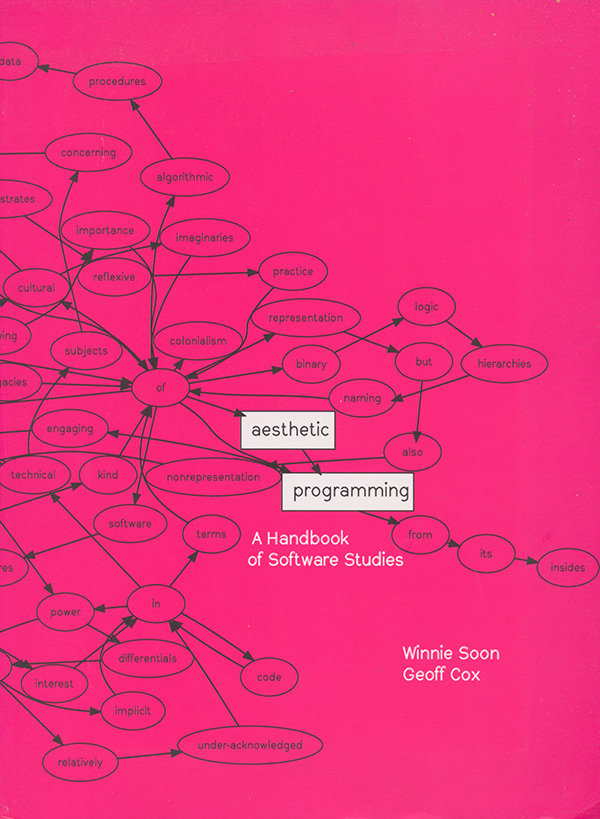
Index
Table of Contents

Preface 11
– What kind of book is this? 13
– Why aesthetic programming? 14
– And software studies? 16
– Open publishing 17
– Flow of contents 18
– The book object 21
– Notes 22

Design notes 25
– Book layout 25
– Fonts 25

1. Getting started 27
– setup() 29
– start() 30
– Working environment 31
– p5.js 32
– Code editor 33
– My first program 35
– Exercise in class 36
– Reading the web console “Hello World” 37
– Reading the reference guide 39
– Git 42
– While() 44
– MiniX: RunMe and ReadMe 46
– Required reading 47
– Further reading 47
– Notes 48

2. Variable geometry 51
– setup() 53
– start() 55
– Source code 56
– Coordinates 58
– Exercise in class 58
– Variables 60
– Why use variables? 62
– Other functions 63
– Conditional structures 63
– Relational operators 64
– Basic arithmetic operators 65
– Discussion in class 66
– While() 66
– MiniX: Geometric emoji 68
– Required reading 69
– Further reading 69
– Notes 70

3. Infinite loops 71
– setup() 73
– start() 74
– Exercise in class (Decode) 75
– Source code 77
– Function 78
– Exercise in class 79
– Transform 79
– push() and pop() 81
– Exercises in class 83
– Asterisk Painting 83
– Source code 84
– Exercise in class 86
– Arrays 87
– Conditional statements 89
– Loops 89
– While() 92
– MiniX: Designing a throbber 93
– Required reading 94
– Further reading 95
– Notes 96

4. Data capture 97
– setup() 99
– start() 100
– Exercise in class (Decode) 101
– Source code 101
 – DOM elements: creating and styling a button 103
– Mouse capture 104
– Keyboard capture 105
– Audio capture 106
– Video/Face capture 107
– Exercise in class 110
– The concept of capture 111
– Web analytics and heatmap 111
– Form elements 112
– Metrics of likes 113
– Voice and audio data 114
– Health tracker 115
– While() 115
– MiniX: Capture All 117
– Required reading 118
– Further reading 118
– Notes 119

5. Auto-generator 121
– setup() 123
– start() 126
– Exercise in class (10 PRINT) 127
– Langton’s Ant 128
– Source code (Langton’s Ant) 131
– Reading Langton’s Ant 133
– Two-dimensional arrays & nested for-loops 134
– Exercise in class 135
– While() 136
– MiniX: A generative program 139
– Required reading 140
– Further reading 140
– Notes 141

6. Object abstraction 143
– setup() 145
– start() 146
– Exercise in class (Decode) 148
– Source code 149
– Class 153
– Objects 154
– Class-Object creation 158
– Exercise in class 158
– Further notes 159
– While() 160
– MiniX: Games with objects 162
– Required reading 163
– Further reading 163
– Notes 164

7. Vocable code 165
– setup() 167
– start() 168
– Exercise in class (Decode) 169
– Textuality 171
– Type 172
– Conditional structure 173
– JSON 175
– Source code 178
– Exercise in class 180
– While() 181
– MiniX: E-lit 184
– Required reading 185
– Further reading 185
– Notes 186

8. Que(e)ry data 187
– setup() 189
– start() 190
– Exercise in class 190
– Image processing: fetching, loading and display 191
– Source code 193
– Exercise: accessing web APIs (step by step) 194
– APIs 196
– Que(e)rying data 197
– Exercise in class 200
– LoadPixels() 201
– Different types of bugs 204
– While() 205
– MiniX: Working with APIs (in a group) 207
– Required reading 208
– Further reading 208
– Notes 209

9. Algorithmic procedures 211
– setup() 213
– start() 214
– Discussion in class 214
– Flowcharts 215
– Exercise in class 217
– Exercise 1 217
– Exercise 2 217
– Flowcharts as an artistic medium 218
– While() 220
– MiniX: Flowcharts 222
– Required reading 223
– Further reading 223
– Notes 224

10. Machine unlearning 227
– setup() 229
– start() 231
– Between input and output 231
– Exercise in class 232
– Learning algorithms 233
– ml5.js library 237
– Source code 238
– Reading Auto Chapter Generator 241
– Exercise in class 243
– While() 243
– MiniX: final project 246
– Required reading 248
– Further reading 248
– Notes 249

Afterword: Recurrent imaginaries 253
– setup() 261
– start() 262
– Cyposate 262
– Source code 263
– p5.trapgares 263
– Style() 263
– Facial literale 264
– Loaded; the section 264
– NaveCode 264
– push and statement 265
– Exercise in class 266
– Learning 266
– Translate then filled respond value areas 267
– structure 267
– Omazo 268
– Open 269
– While() 269
– MiniX: Geometric disclmmediated mobinal 270
– Required reading 272
– Further reading 272
– Notes 273

Bibliography 275
List of Projects 287
Acknowledgments 291
Colophon 295

donated by Winnie Soon


#artandtechnology #arttech #artandtech #arttechnology #informationdesign #codedart #timebasedart #informationart #digitalaesthetics #softwareart #creativecoding #creativecodeart #codeart #algorithmicart #creativetechnology #interactiondesign #digitalcultures #technoculture #experiencedesign #interactiveexperience #criticaltheory #criticalinformationstudies #mediatheory #mediastudies #mediaculture #digitalhumanities #digitalstudies #informationtheory #neuralarchive #neuralmag